 EN
EN

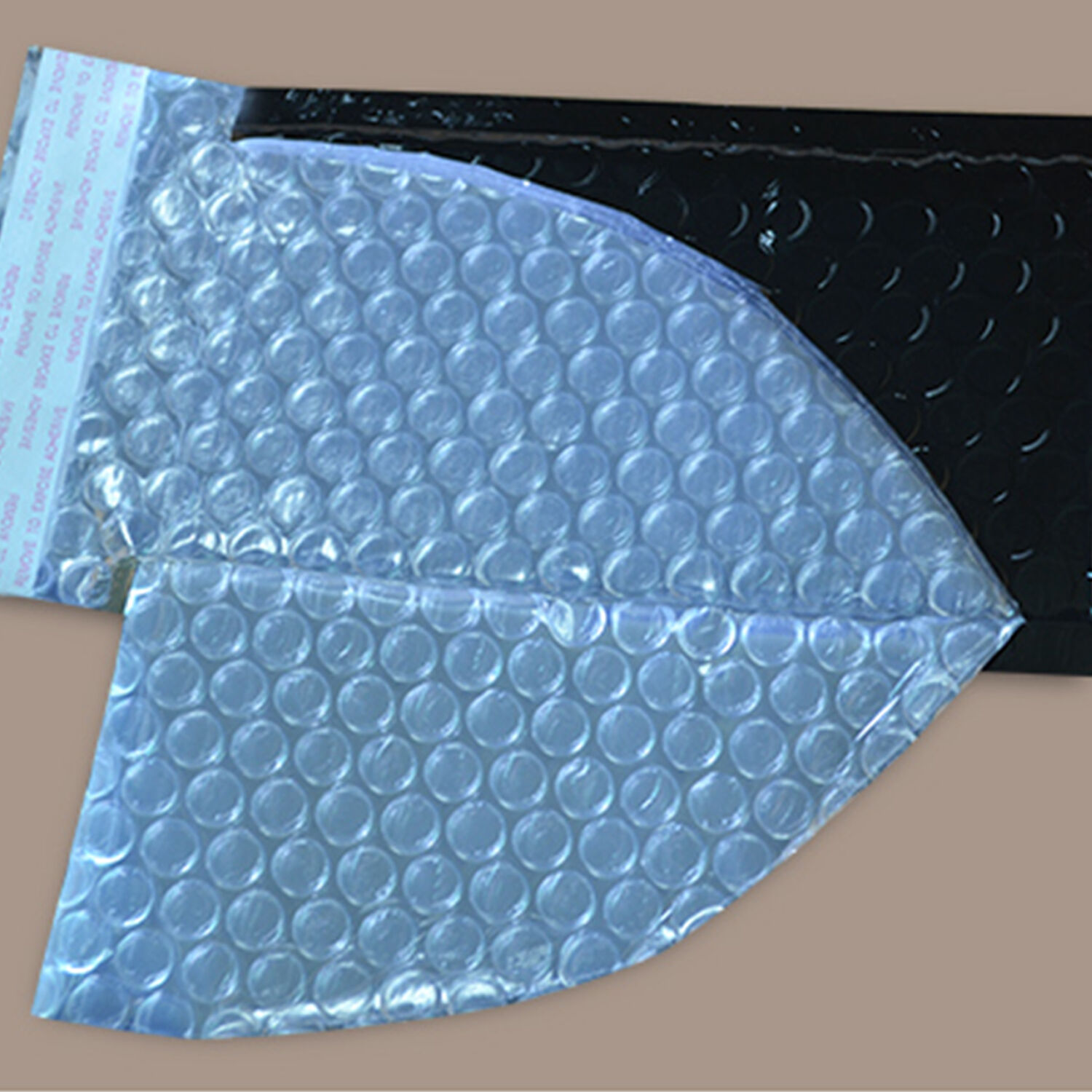
Unmatched Impact Protection for Fragile Electronics
Physics of Bubble Cushioning: How Air-Filled Voids Absorb and Dissipate Drop Energy for Earbuds, PCBs, and Sensors
Bubble envelopes leverage a fundamental principle of impact physics: trapped air pockets deform progressively under load, converting kinetic energy into heat and internal gas compression. When a package strikes a surface, the bubbles compress at a controlled rate—absorbing shock rather than transmitting it directly to the contents. This mechanism remains effective across common drop heights (24–36 inches), especially for lightweight electronics under 12 ounces. A single layer of ⅜-inch bubbles can reduce peak impact force by over 70% compared to an unlined poly mailer. The closed-cell structure prevents bottoming out on sharp edges, ensuring consistent deceleration. Manufacturers tailor bubble diameter and film thickness to match product fragility—making bubble envelopes a precise, scalable solution for earbuds, PCBs, and sensitive sensors.
Real-World Performance: ASTM D4169 Drop-Test Data Comparing Bubble Envelopes vs. Corrugated Boxes
ASTM D4169—the industry-standard protocol for evaluating shipping container performance—confirms that well-specified bubble envelopes deliver protection on par with corrugated boxes for sub-2-pound electronics. In standardized 24-inch free-fall tests, bubble envelopes with a ¼-inch bubble layer consistently protect a 6-ounce fitness tracker without damage. While corrugated boxes with foam inserts yield marginally lower peak G-forces at higher drops (e.g., 36 inches), the performance gap narrows significantly for packages under 1 pound—where bubble envelopes often match or exceed alternatives in real-world handling. The table below summarizes representative results:
| Package type | Bubble cushion thickness | Peak G‑force at 24‑inch drop (6 oz load) | Pass/fail for common IoT sensor |
|---|---|---|---|
| Bubble envelope (poly) | ¼ inch | 85 G | Pass |
| Bubble envelope (kraft) | ⅜ inch | 72 G | Pass |
| Corrugated box + foam insert | 1 inch foam | 68 G | Pass |
| Corrugated box + air pillows | 2‑inch pillow | 90 G | Pass |
For small, lightweight electronics, bubble envelopes provide comparable impact mitigation while reducing material use, labor, and dimensional weight penalties—making them both technically sound and operationally efficient.
Cost and Weight Efficiency Without Sacrificing Security
Shipping cost savings: 60–75% weight reduction eliminates dimensional pricing penalties with USPS and UPS
Bubble envelopes cut total package weight by 60–75% versus rigid corrugated boxes—effectively eliminating dimensional weight surcharges imposed by USPS, UPS, and FedEx. Because carriers calculate shipping costs based on the greater of actual or dimensional weight, this reduction translates directly into lower freight expenses. Crucially, the weight savings occur without compromising shock absorption: properly sized bubble envelopes maintain protective integrity even for sensitive components like MEMS sensors and surface-mount PCBs.
Total landed cost analysis: $0.38/bubble envelope vs. $1.22/box + void fill for sub-12 oz electronics
When evaluating total packaging cost—including materials, labor, storage, and shipping—bubble envelopes deliver compelling economics for sub-12-ounce electronics. At an average unit cost of $0.38 per envelope versus $1.22 for a corrugated box plus void fill, bubble mailers represent a 68% reduction in packaging spend. This advantage compounds across high-volume fulfillment: no assembly time, minimal storage footprint, and compatibility with automated insertion systems further reduce operational overhead—all while preserving product safety.
Electronics-Specific Functional Features
Moisture Resistance and ESD Safety: Poly vs. Kraft Bubble Envelopes Tested per ASTM E96 and ANSI/ESD S20.20
Electronics demand dual protection: against moisture ingress and electrostatic discharge. Poly bubble envelopes excel in both areas. Per ASTM E96 testing, polyethylene film exhibits a water vapor transmission rate (WVTR) under 0.5 g/100 in² per 24 hours—far superior to kraft paper, which can absorb up to 15% moisture by weight in humid conditions. That makes poly envelopes ideal for moisture-sensitive devices like IoT sensors and assembled PCBs. For ESD safety, carbon-fiber–treated poly bubble envelopes meet ANSI/ESD S20.20 requirements for surface resistivity (10⁶–10⁹ Ω/sq), offering reliable static dissipation. Untreated kraft provides no inherent ESD control. One global electronics manufacturer reduced ESD-related field failures by 78% after standardizing on anti-static poly bubble envelopes—a testament to their functional reliability.
Precision Fit and Scalable Sizing for Common Small Electronics
Dimensional optimization guide: matching standard bubble envelope sizes (6" × 9", 9" × 12") to high-volume SKUs like USB-C cables, fitness trackers, and IoT modules
Optimal protection begins with precise fit. The 6" × 9" bubble envelope accommodates slim, flat items—such as USB-C cables, thin IoT sensor modules, and folded circuit boards—with minimal internal void space. The 9" × 12" size offers slightly more volume for bulkier but still compact electronics, including fitness trackers, compact earbud cases, and small battery-powered sensors—leaving just enough room for optional antistatic bags or ultra-thin foam liners if needed. A snug fit eliminates in-transit movement—the leading cause of mechanical damage to solder joints and micro-connectors. It also removes the need for secondary void fill, cutting material waste and packing time. These two standard sizes are widely available from major suppliers and integrate seamlessly with automated packaging lines, supporting rapid scaling without sacrificing consistency or protection.
FAQ
Why are bubble envelopes effective for fragile electronics?
Bubble envelopes use air-filled pockets to absorb and dissipate shock, protecting fragile electronics like earbuds and PCBs during transit.
How do bubble envelopes compare to corrugated boxes in terms of protection?
For lightweight electronics, bubble envelopes provide protection comparable to corrugated boxes while reducing material use and weight.
Are bubble envelopes cost-efficient?
Yes, bubble envelopes reduce packaging costs by up to 68% compared to boxes with void fill, while also minimizing storage and labor expenses.
Do bubble envelopes protect against moisture and static discharge?
Poly bubble envelopes are moisture-resistant and meet ESD safety standards, making them ideal for sensitive electronics.
What sizes of bubble envelopes are available for electronics?
Standard sizes like 6" × 9" and 9" × 12" are optimal for most small electronics, such as USB-C cables and fitness trackers.
Table of Contents
- Unmatched Impact Protection for Fragile Electronics
- Cost and Weight Efficiency Without Sacrificing Security
- Electronics-Specific Functional Features
- Precision Fit and Scalable Sizing for Common Small Electronics
-
FAQ
- Why are bubble envelopes effective for fragile electronics?
- How do bubble envelopes compare to corrugated boxes in terms of protection?
- Are bubble envelopes cost-efficient?
- Do bubble envelopes protect against moisture and static discharge?
- What sizes of bubble envelopes are available for electronics?